
Engineer Wei
4. Sept. 2026
In a laboratory, some instruments may not attract much attention, yet they perform essential work before analysis begins. The VPI SD-900M Magnetron Sputter Coater is one of them. It does not produce the final image, but it plays an important role in determining whether a sample can be observed clearly and consistently.
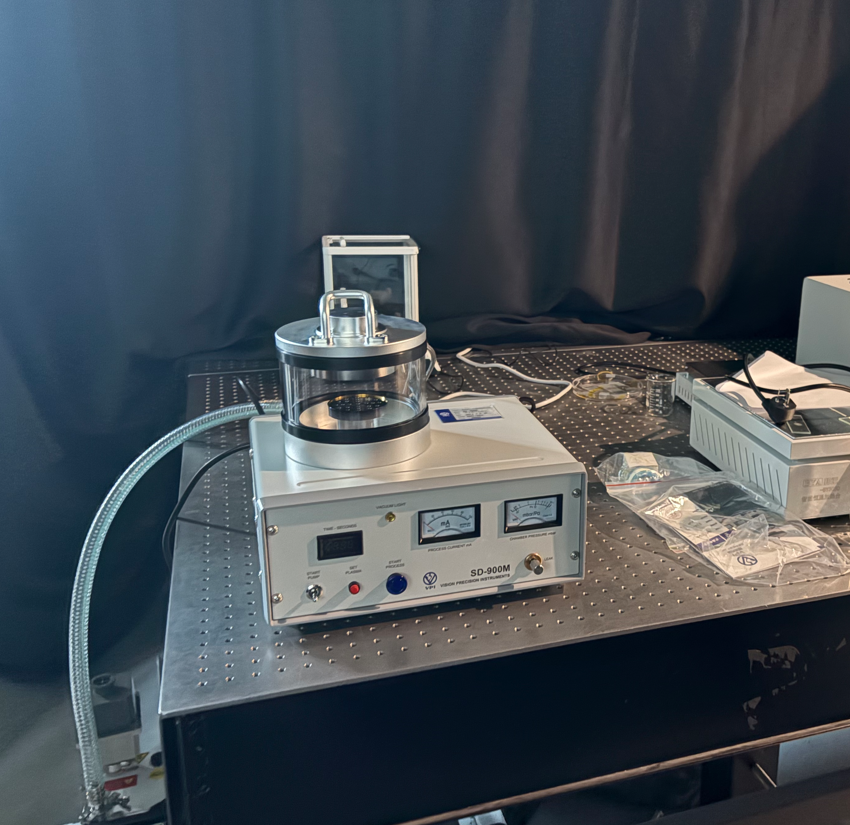
VPI SD-900M Low-Vacuum Magnetron Sputter Coater at Beijing Information Science and Technology University
In a laboratory, some instruments may not attract much attention, yet they perform essential work before analysis begins. The VPI SD-900M Magnetron Sputter Coater is one of them. It does not produce the final image, but it plays an important role in determining whether a sample can be observed clearly and consistently.
At the Modern Optoelectronic Testing Technology Laboratory of Beijing Information Science and Technology University, the SD-900M is installed on a laboratory workbench. Together with a vacuum pump and sample preparation supplies, it forms a compact sample preparation unit. From sample preparation to microscopic characterization, a clear and reliable image often begins here.
Why Coat a Sample Before Imaging?
When low-conductivity samples such as polymers, fibers, ceramics, and biological materials are examined using a scanning electron microscope (SEM), the electron beam can cause charge to accumulate on the sample surface. This may result in excessively bright areas, image drift, or abnormal contrast.
Depositing a thin, continuous conductive coating on the sample surface helps dissipate this charge and improves imaging stability.
However, a thicker coating is not necessarily better. A coating that is too thin may fail to form a continuous conductive path, while one that is too thick may obscure fine surface structures. The coating conditions should therefore be adjusted according to the sample properties, target material, imaging objectives, and SEM parameters.
SD-900M Makes the Process More Intuitive
The SD-900M can be used to deposit conductive metal coatings on non-conductive or heat-sensitive SEM samples. It is also suitable for laboratory surface treatment applications.
A range of target materials, including Au, Ag, Pt, and Au/Pd, allows researchers to select a suitable coating based on the sample and imaging requirements.
Its intuitive operation makes the SD-900M particularly suitable for university laboratories. Instructors can quickly assess the equipment status, while students can connect concepts such as vacuum pumping, plasma discharge, and thin-film deposition with the actual process taking place inside the chamber.
Turning a Coating Run into a Repeatable Process
Reliable daily sample preparation depends on several fundamentals: checking the sample, mounting it securely, setting appropriate parameters, and keeping accurate experimental records.
For a new sample, researchers can begin with relatively conservative settings, make small adjustments to the coating time and current, and record how each set of conditions affects subsequent SEM imaging.
On a shared research platform, these records gradually become part of the laboratory’s accumulated sample preparation knowledge. The SD-900M then becomes more than a standalone instrument: it serves as a dependable link between sample preparation and microscopic characterization.
A well-designed laboratory instrument does not always need to take center stage. It is more like a reliable partner: easy to understand, convenient to document, and ready to hand the spotlight back to the sample and the data once its work is complete.
With the VPI SD-900M, every clear characterization begins with careful, controlled sample preparation.